The independently adjustable hour hand (IAHH) refers to the ability to move the indicated time on a watch forwards or backwards by whole hours1 without disturbing timekeeping. The most common reasons to do this are when crossing time zones, or daylight savings time (DST).
Terminology
Some call the IAHH a ‘jumping hour’, but that term already refers to an hour indication that snaps from one hour to the next at the turn of each hour.
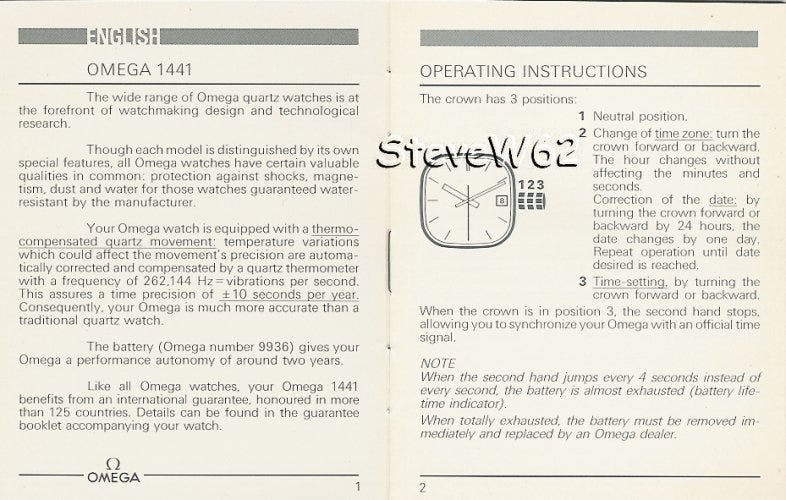
Omega call this feature the ‘time zone function’. Omega were the first to provide IAHH in a quartz watch in the cal. 1511/1510 movements of the Omega Marine Chronometer and Audemars Piguet 6001. Omega continued to provide IAHH in its leading calibers of both types, such as their first fully in-house quartz cal. 1310, the thermocompensated cal. 1441, the co-axial escapement cals. 8500/8900, and the modern chronograph cals. 9900/9906.
IAHH in Omega cal. 1441 instructions preserved at Old-Omegas.com
This feature is called ‘travel time’ within Patek Philippe, where it is associated with a pair of side pushers. However, there are at least two Travel Time calibers, the quartz E 23-250 S FUS 24H and one annual calendar, which provide adjustment by the crown.
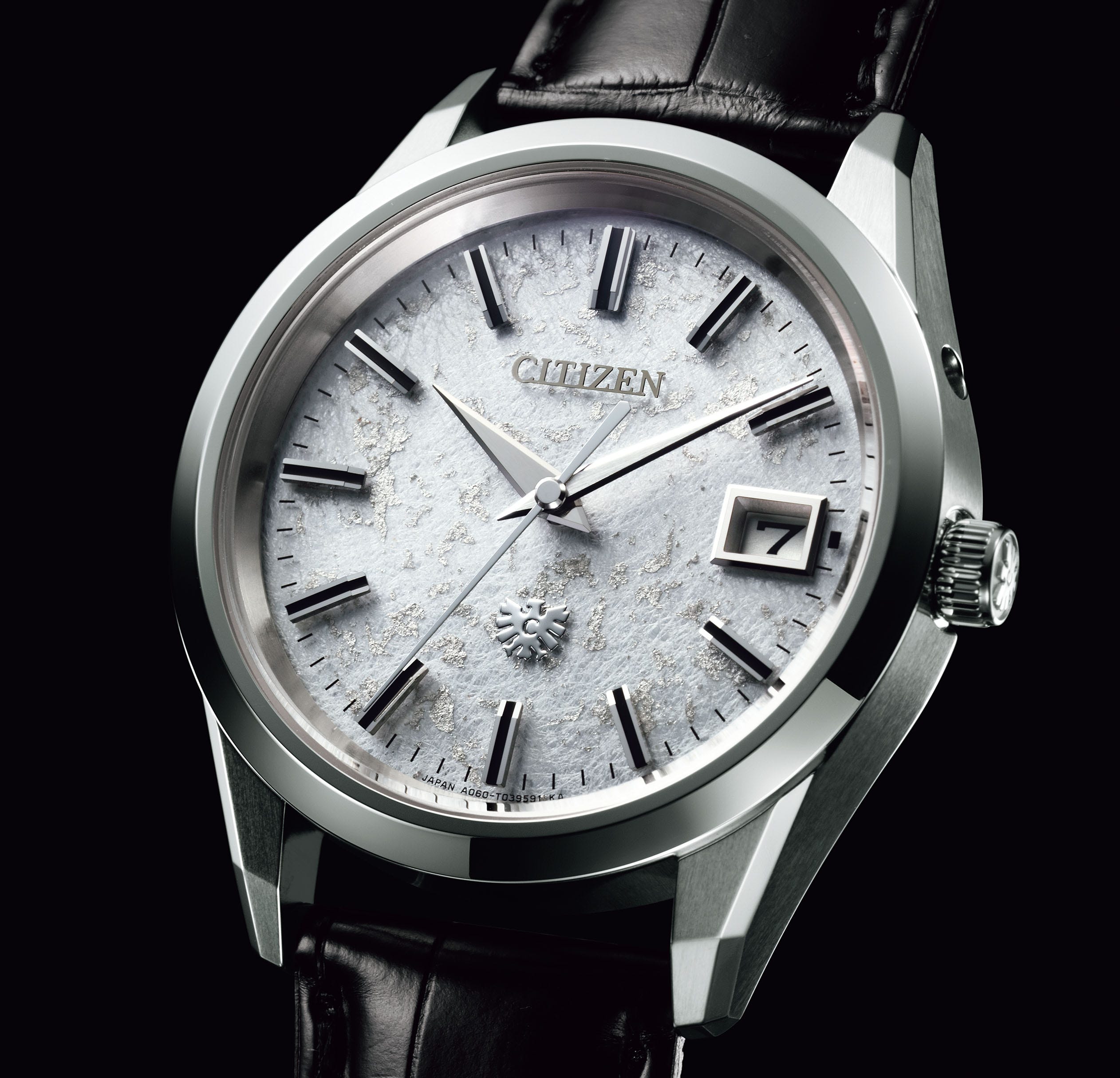
Citizen and Seiko call this an ‘independent hour hand’, implementing it in almost all radio- and GPS-corrected watches (including non-GMT models), as well as flagship autonomous quartz calibers such as Citizen cals. A010, A060, and 0100, Seiko cal. 9F85, and the Micro Artist Studio cal. 9R01.
The IAHH is also a necessary feature of every ‘traveler’ or ‘true’ GMT watch. From a movement point of view, every such GMT watch is merely an IAHH-type watch, plus a 24H (or in some cases 12H) ‘home time’ hand which moves with the minute hand in the normal way. Therefore, an alternative way of looking at non-GMT watches with IAHH is that inside is a traveler GMT movement with the GMT works removed.
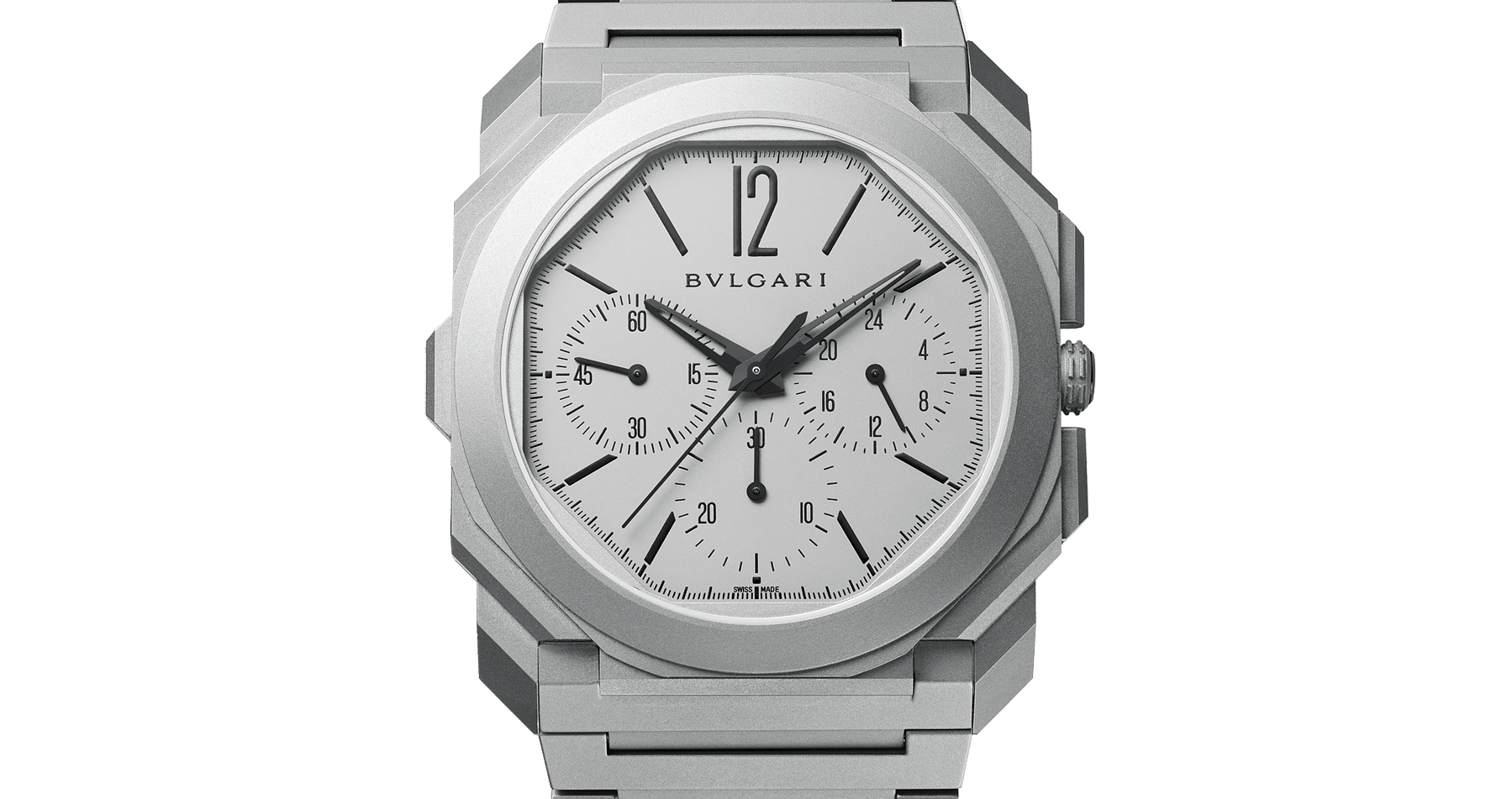
Bulgari’s cal. BVL318 provides an IAHH, advanced by the 9 o’clock pusher
What are the reasons to provide IAHH in a non-GMT watch?
Convenience value
This article will not try to establish when IAHH first appeared, but Patek Travel Time watches have offered the IAHH as a convenience feature. Louis Cottier, after patenting the world timer mechanism in 1931, invented a dual-pusher user interface for adjusting the IAHH in 1959.
Cottier began working on the Heure Sautante (H.S., “jumping hour”) in 1956/57, a mechanism that allowed wearers to adjust the hour independently without pulling the crown or changing the minutes. This offered a significant advantage when changing time zones, particularly since precise time references for setting personal watches were not as ubiquitous as they are today.
The convenience value of assigning something other than the crown for hour hand adjustment is due to the danger posed to the crown stem of trying to manipulate the crown with the watch still on the wrist. This was underlined by Hodinkee coverage:
By the mid-1950s, Patek wanted more options for travelers, and it called upon Cottier to design a time-zone jumping watch that could be updated without stopping the minutes or seconds and without taking the watch off of one's wrist.
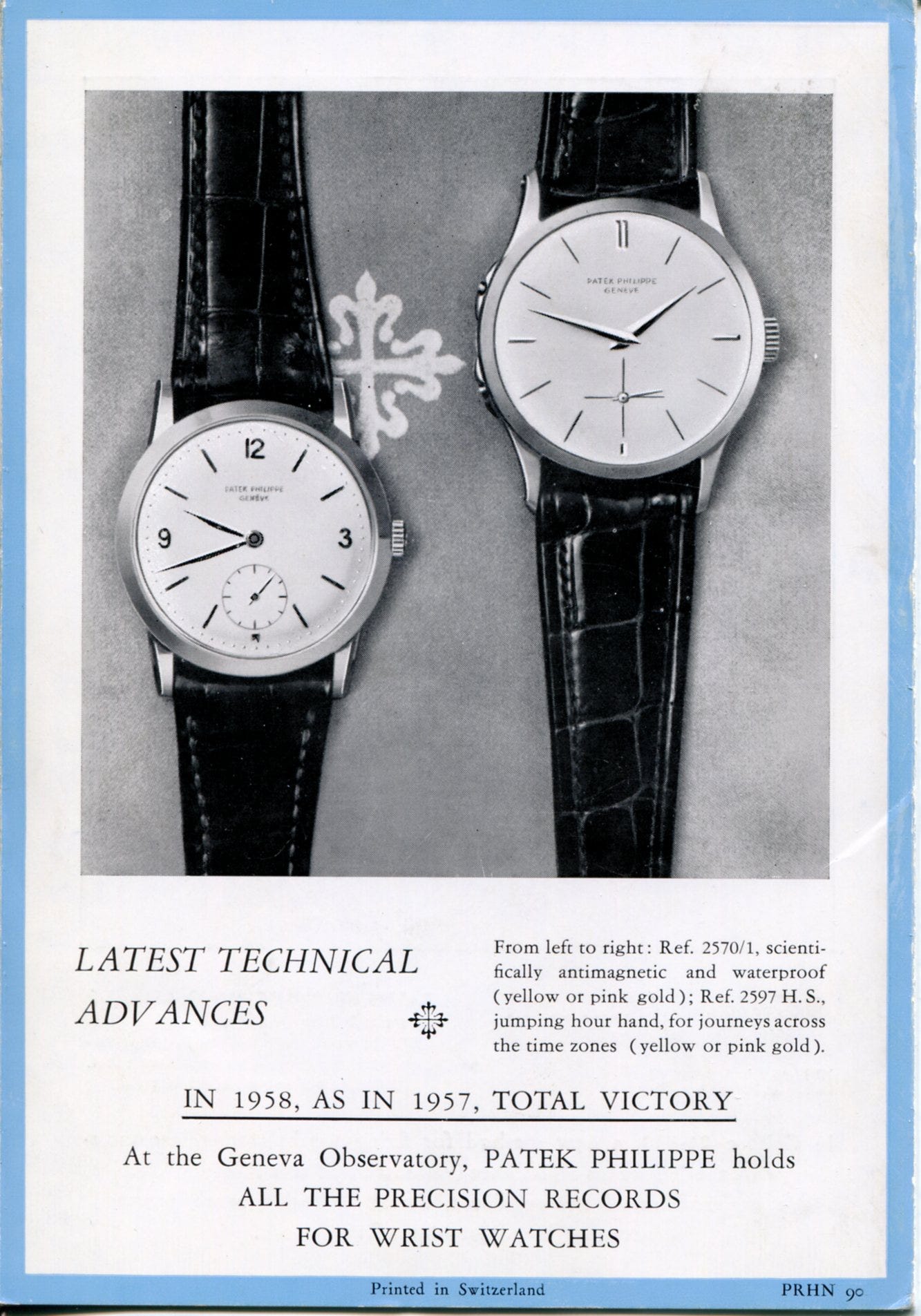
The initial watches with Cottier’s mechanism didn’t have a ‘home time’ hand. In other words, they were 3-hand watches with IAHH:
Patek ad referring to the IAHH as a ‘jumping hour hand’. And boasting about superior accuracy; how quaint. Image from Hodinkee
Accuracy value
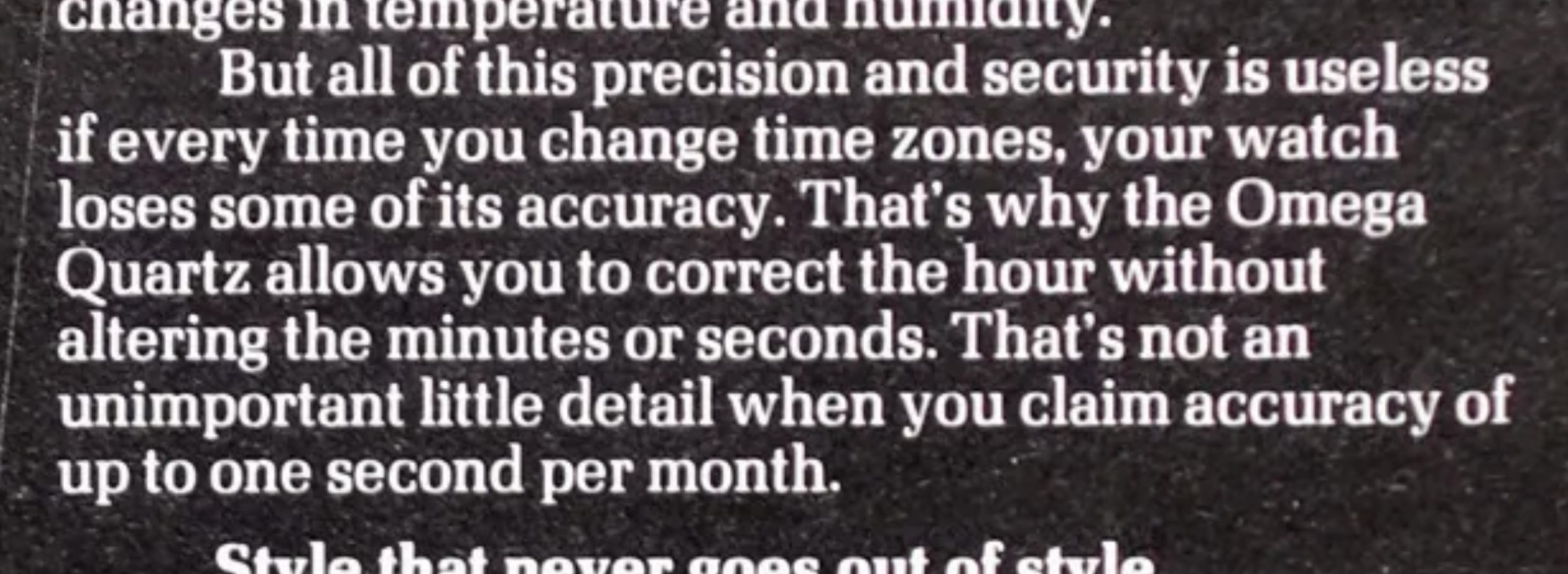
Without an IAHH, any time zone or DST change typically involves ‘hacking’ the watch to spin the minute hand around one or more times. Fify years ago, Omega adveritising alluded to this:
The reason for Omega not offering pusher-based hour adjustment in their dress and casual watches may not be due to Patek’s patent only. In a wrist-worn marine chronometer, it is desirable that the hour be not that easy to adjust, because unlike landlubbers, the seafarer cannot count on there being some other time indication around to alert him that the hour is off.
Aesthetic value
Closer to the present, when Grand Seiko finally added IAHH to its mature 9F quartz line with the cal. 9F85 in 2020,2 in a contemporary context where few watches are critical timekeepers, veteran Nobuhiro Koike framed it as an aesthetic value, at least to the extent that autonomous high accuracy quartz timekeeping today is valued for aesthetic reasons:
When you go to a country in a different time zone, you adjust your hour hand to the local time. This might not present an issue for a regular watch, but for the 9F caliber, we’re speaking about seconds per year accuracy.
Plus9TIme proprietor Anthony Kalbe said to me as we discussed our mutual hope of seeing a Spring Drive UFA with IAHH soon (emphasis mine):
I think the IAHH makes perfect sense for a UFA. It has never really made much sense to have a super accurate annual rate watch that you have to hack and stop the accuracy whenever there is a time zone change of somewhere with daylight savings.
Aesthetics in being able to avoid an unnecessary disturbance to timekeeping operation is thus the final value of the IAHH, after convenience and accuracy.
How then is the IAHH implemented?
Electronic approach to the IAHH
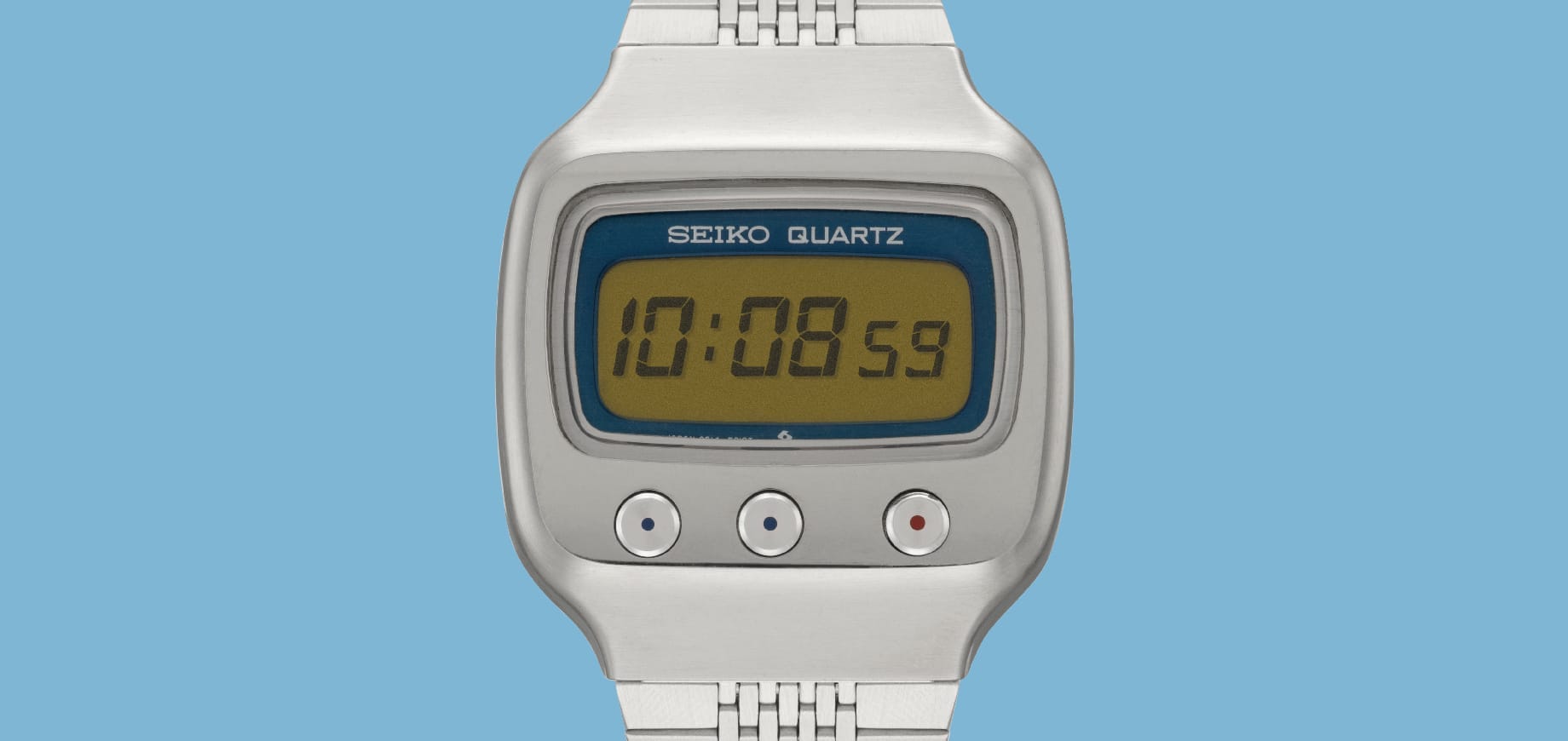
Digital watches are simplest for IAHH because they have no ‘hands’. The Seiko cal. 06LC3 could adjust hours and minutes independently of the seconds, which continued to count forward. The feature is ubiquitous in digitals today.
1973 Seiko 06LC V.F.A. In time setting mode, the three front buttons corresponded to hours, minutes and zero-reset of seconds. Image from Seiko Design 140.
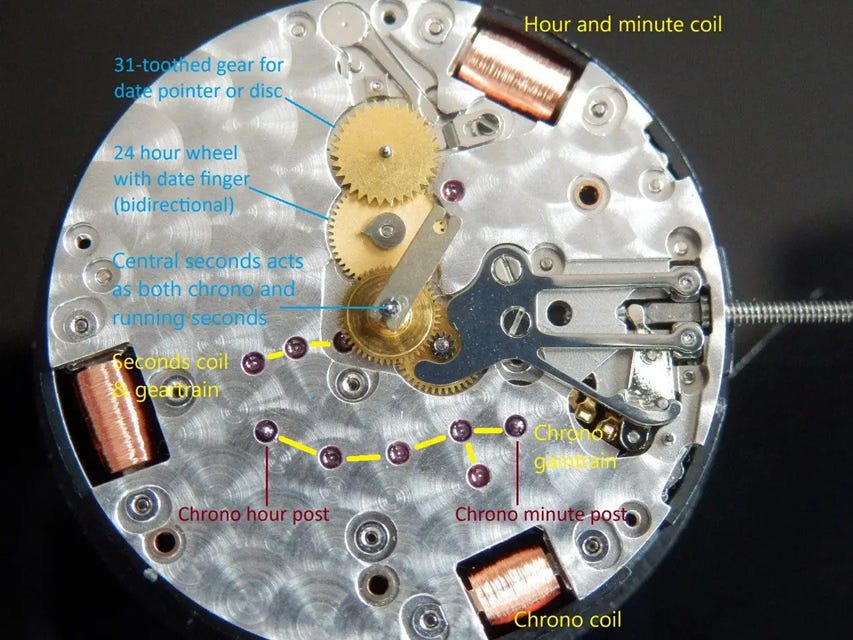
While analog quartz watches commonly drive all the hands by gears from the seconds hand, some provide a separate motor for hours or minutes/hours, or have no seconds hand. These can be programmed to motor the hours forward and backward. If there is a minute hand, it is spun 60 times to adjust the hour. For example, the Piaget cal. 212P, known in Cartier as the ‘Chronoreflex’ movement, takes this approach.
Three independent geartrains of the Piaget cal. 212P. The minute and hour (and date) are driven from the top right coil, separately from the seconds. This enables the seconds hand to serve both time indication and the chronograph as needed.
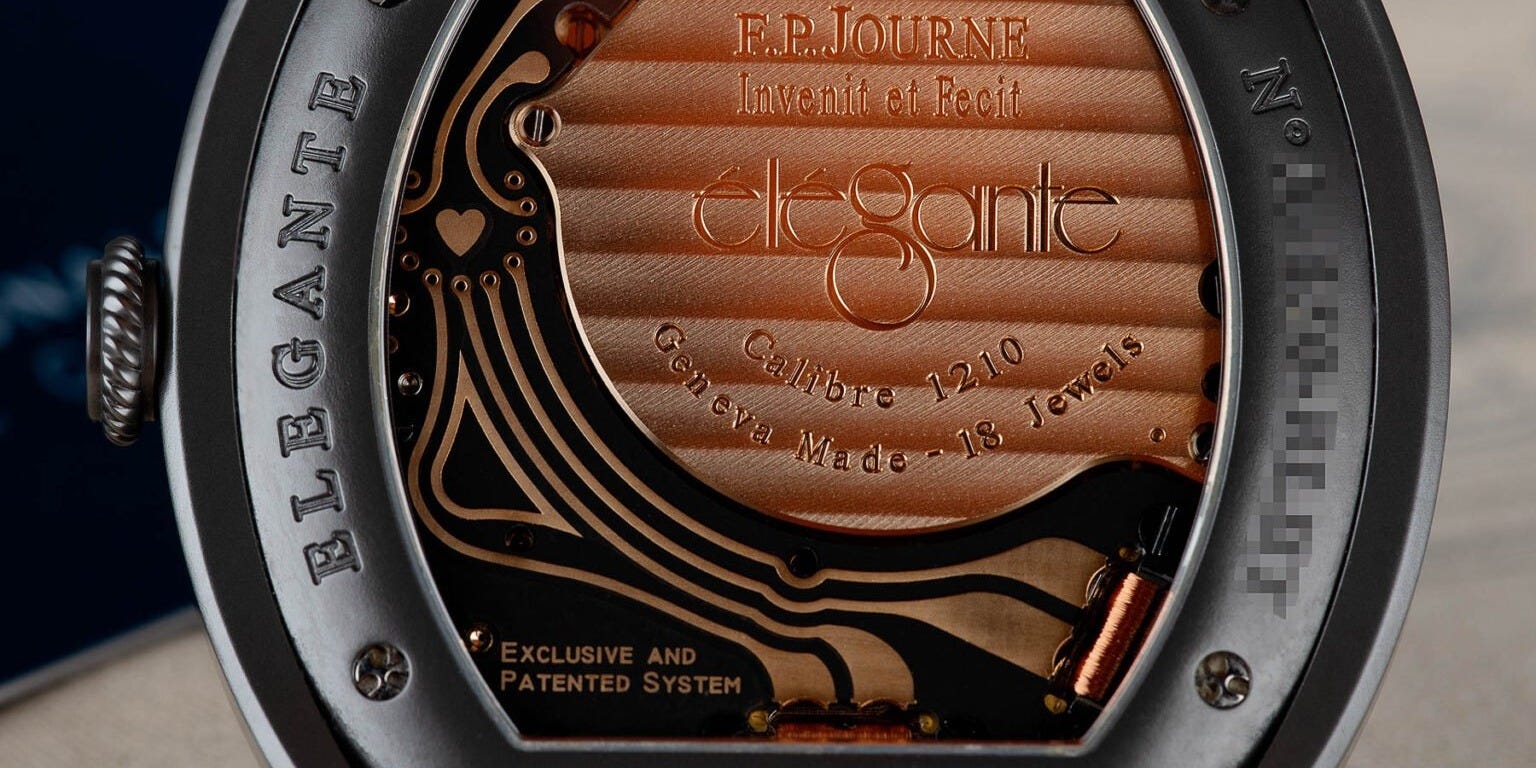
Not all such movements take advantage of the opportunity to provide IAHH, as a user interface for commanding the hour adjustment is still required. For example, the F.P. Journe cal. 1210 has a dedicated motor and geartrain for hours:minutes. The separation is used only for energy savings, where, after any period of dormancy, the IC motors the hours and minutes to match the internally-stored time.
Montres Journe cal. 1210 displaying two motor coils at bottom and bottom right
Radio- and GPS-corrected watches also generally motor the necessary hands forward or backwards to effect changes of the local hour.
The present- generation Omega Speedmaster X-33 watches provide IAHH on both analog and digital time displays. The user sets an explicit offset value between UTC and local time zone ‘T1’. This offset can be set in 15 minute increments.
Mechanical approach to the IAHH
Mechanical watches cannot adjust the hour hand by electronic means. Some quartz watches also choose to implement the IAHH in a mostly or even purely mechanical way.
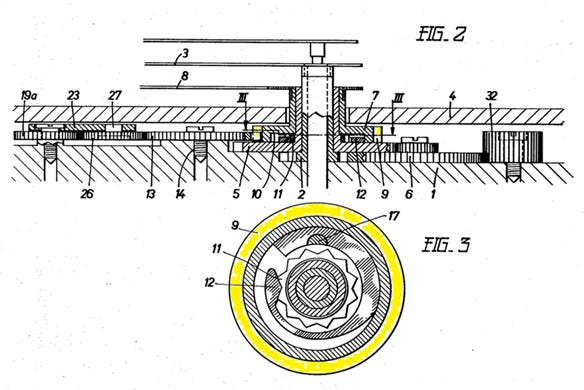
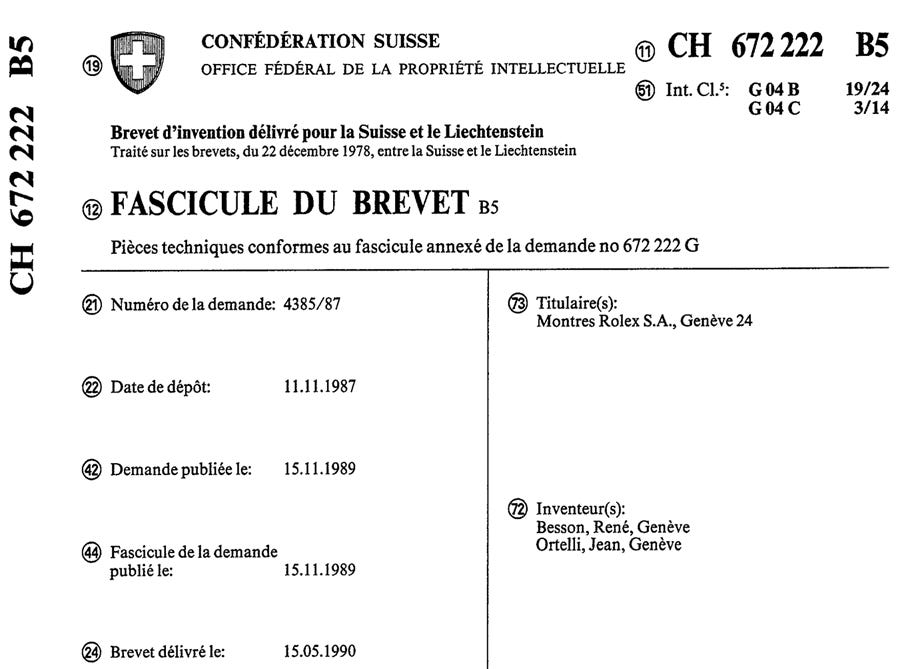
The basic setup is a 12-toothed pinion and jumper spring, which provides the necessary detents. The hour hand is mounted on the pinion, while the jumper is counted on the hour wheel. Below diagram from a 1969 Rolex patent illustrates a 3-hand movement with IAHH. The pinion is #11. One end of the jumper spring, marked #12, is resting between two teeth of the pinion.
Aside on GMT or dual time hand stacks
The preceding diagram also illustrates how the IAHH works (#9 in yellow) occupies the topmost plane in the 3-hand movement shown. Due to this fact, adding a 24H hand below the IAHH in the hand stack is mechanically inconvenient compared to adding it above the IAHH. The Rolex GMT-Master II hand stack to this day has the GMT hand above the IAHH.4
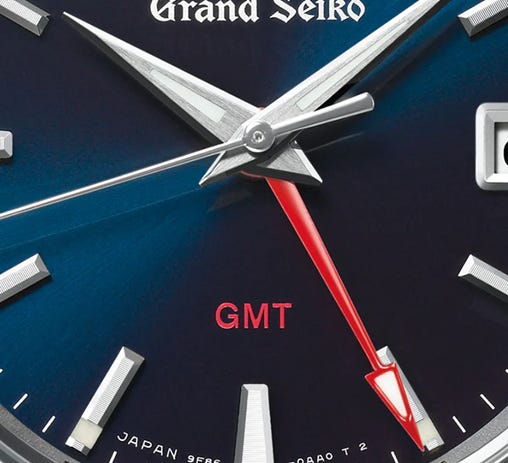
Some GMT watches avoid Rolex’s approach for aesthetic reasons, even at the cost of a taller hand stack. (The hour hand doesn’t have to clear the hour markers, but typical GMT hands do.) One prominent example is Grand Seiko GMTs, where the complex hour and minute hands would be marred by an interposed GMT hand.
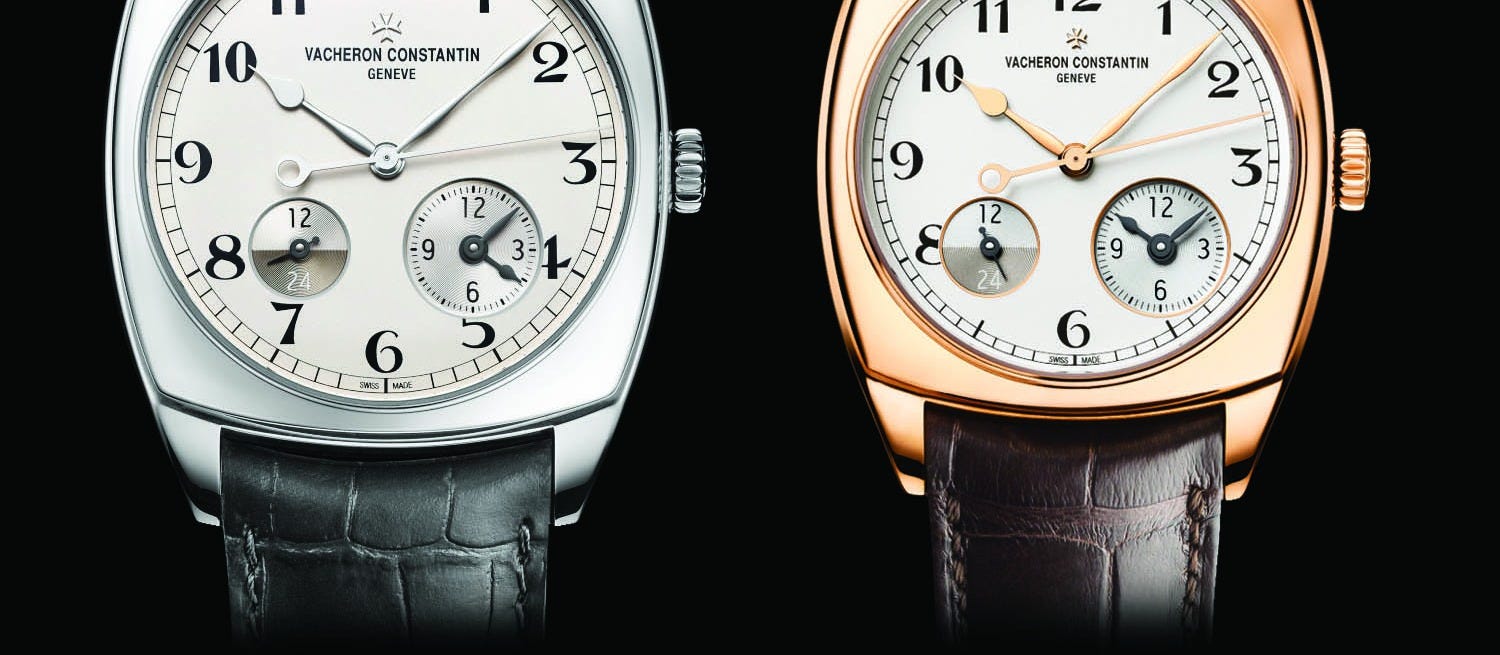
Any watch where the 24H or ‘home time’ indication is on the dial is mechanically similar in the abstract to placing the GMT hand bottommost, because the bottommost hand is the one adjacent to the dial. Examples include the Rolex Sky-Dweller and the VC Harmony Dual Time.
Vacheron Constantin Harmony Dual Time in two sizes. The hour hand is an IAHH while the subdials all indicate ‘home time’.
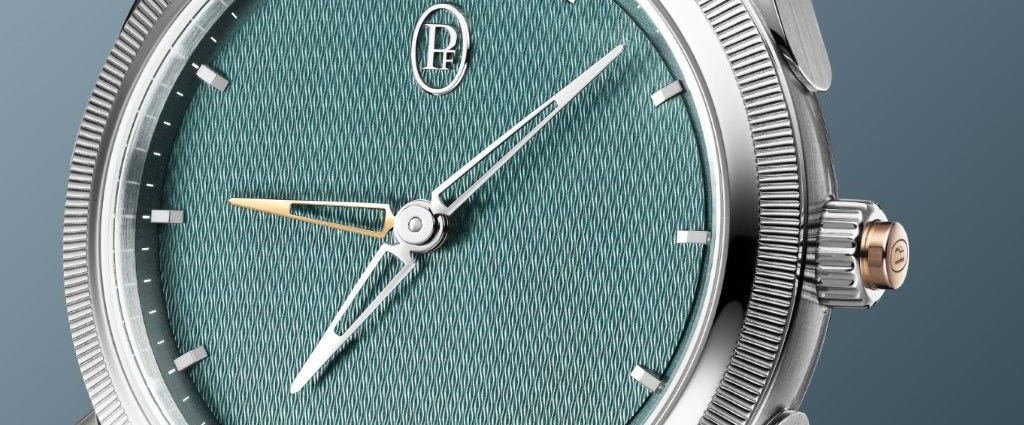
In the ‘hidden’ home time hands of Patek Travel Time watches, the Tonda PF GMT Rattrapante, etc., it is desirable that the IAHH is higher in the stack, so that, when back home, the differently-colored ‘home time’ hand is the one covered by the normal-colored IAHH.
The upshot is that there is no ‘right’ GMT hand stack. It depends on the design objectives.
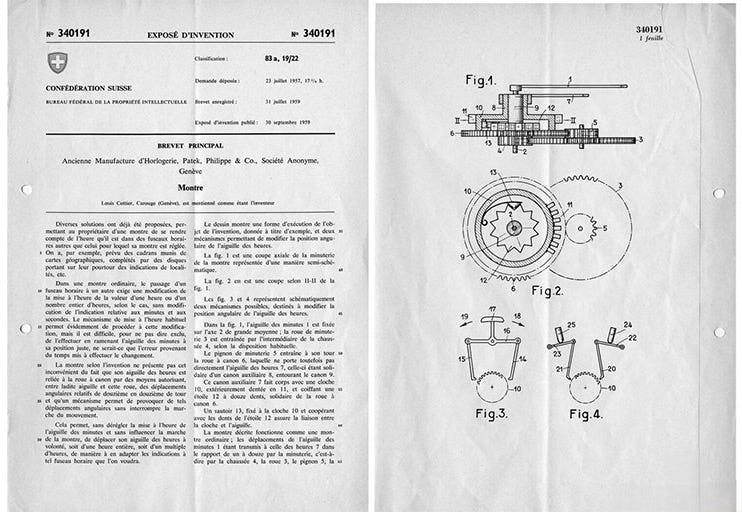
Patek Philippe’s characteristic pusher-style interface for adjusting the hours is already apparent in Louis Cottier’s 1959 patent below, in figure 4. The 12-toothed pinion and a very delicate-looking jumper spring are drawn in figure 2.
Swiss patent 340191 for Cottier’s push button travel time mechanism. Image from Collectability
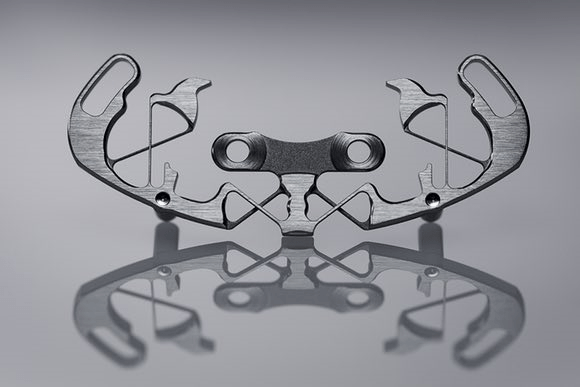
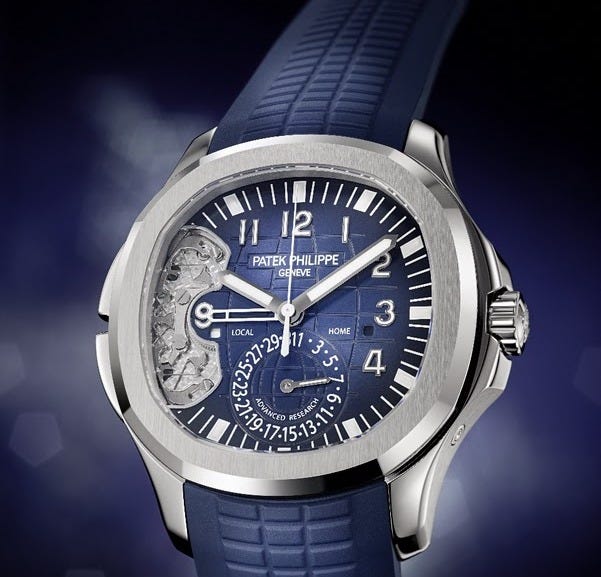
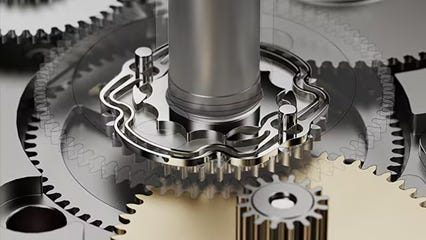
In 2017, the firm offered the ref. 5650 Aquanaut Travel Time Advanced Research, with a compliant mechanism to replace many small parts of the pusher system. By comparing the photo below with Cottier’s 70-year old diagram, one can see where the ‘claws’ of the new part engage.
Of this part, which Jack Forster dubbed the ‘crab’, he wrote (hyperlink aded by me):
The level of precision required probably could not be achieved with classical methods – the clearance between the leaf springs, where they form an "x," is only 150 microns – but the whole thing is hand-finished (which must have been, given the configuration of the mechanism, and to put it colloquially, a royal pain in the ass for whomever had to do it) and it looks very cool as well. It has a kind of intuitive appeal; almost no one could imagine such a thing but the basic principle, and construction, seem obvious and self-evident when you see it working. The easiest way to understand how it works is to watch this little short
Considering that this same 2017 watch also debuted a new inner terminal curve of the Spiromax hairspring and a new accuracy spec of -1/+2 s/day, I think it is fair to say that that the watch was a deliberate pairing of accuracy-enhancement with accuracy-preservation (with a dollop of convenience).
Aquanaut Travel Time Advanced Research ref. 5650G. The IAHH is the ‘travel time’ hand while ‘home time’ is skeletonized to tuck underneath it.
Complicating complications
An IAHH is simple enough in concept, but what about IAHH with (local) date (such as the preceding Aquanaut)?
Any IAHH-and-date movement must satisfy three requirements:
forwards adjustment of the hour past midnight must increment the date;
backwards adjustment past midnight must decrement it; and
adjustment at all possible positions of the hour and minute hand should be allowed.
Date mechanisms designed only to advance the day, or which rely on an extended period of time advance to load the date jumper, or movements which are compromised by the variability of resistance transmitted to the gear train, will be insufficient.
Omega has long provided bidirectional IAHH with date mechanically. So have the longstanding GMT calibers of Rolex, Omega, Glashutte Original, Grand Seiko, Oris, etc. But this does not mean there is no room for mechanical improvement.
IAHH with instant date change
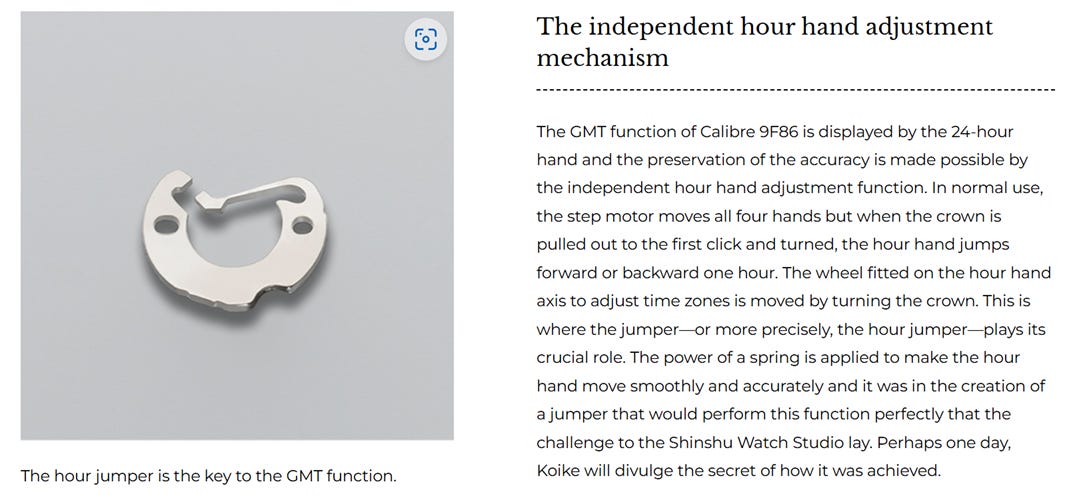
The Grand Seiko 9F quartz calibers lacked IAHH for twenty years because 9F has always had instant date change, but the engineers did not yet know how to fashion the IAHH+instant-date mechanism to the requisite standard of durability.5 This finally materialized in 2019 in the 3-hand cal. 9F85 and GMT cal. 9F86.
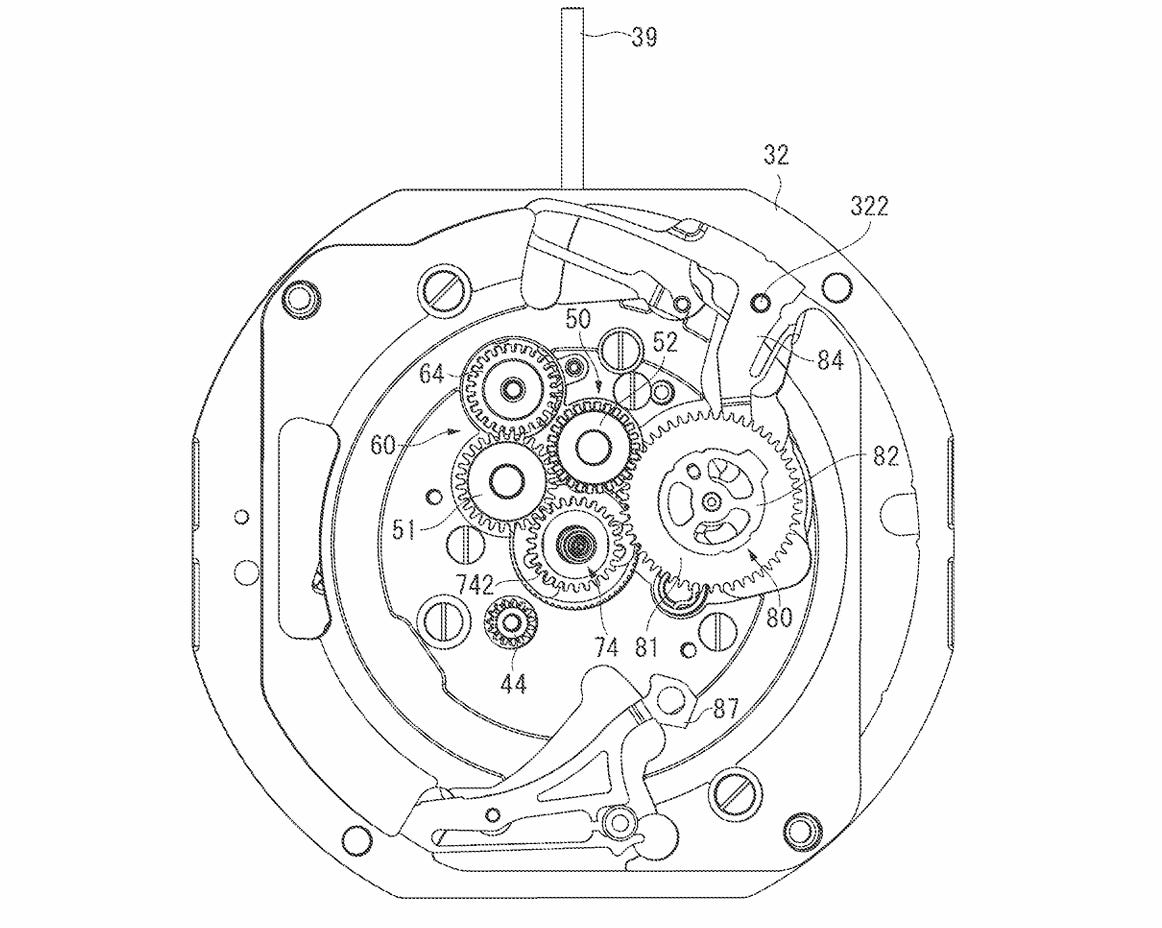
The basic mechanical design is outlined in the associated patent6 (PDF attached). The interaction between IAHH and date change is discussed:
Because the date change lever 84 of the date change mechanism 50 must be advanced by rotation of the hour wheel body 74, greater torque is required to turn the hour wheel body than in a conventional date change mechanism that does not have a date change lever.
Purely mechanical IAHH with bidirectional instant date change from Seiko Epson patent. Note the large date jumper (#84)
To overcome this force, the hour jumper had to be strengthened:
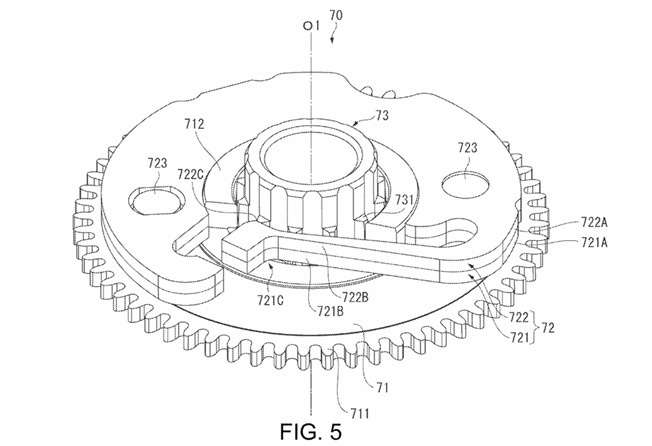
The torque of the hour jumper 72 is used to turn the hour wheel body 74, and must therefore be greater than the load torque of the hour wheel body 74. More specifically, the spring force (urging force) of the hour jumper 72 must be greater than the load torque of the hour wheel body 74. As a result, in this embodiment as described above, the hour jumper 72 comprises two hour jumper members [stacked on top of each other]
Hour jumper pinion (#73) with 12 detents for the stacked jumper springs (#721 #722), arranged atop the hour wheel (#71), from Seiko Epson patent
The published Grand Seiko photograph therefore is showing only one such jumper spring:
IAHH with electronic calendar
The Citizen cal. A060 has no mechanical link between IAHH and date, because it uses a dedicated motor to drive its perpetual calendar indication. The watch also needs no month and year indicators, because the independent seconds hand is used to indicate such information in calendar programming, a technique first patented by Rolex7 in 1987 for their never-commercialized Oysterquartz Perpetual Calendar Datejust and Day-Date (which also had IAHH).
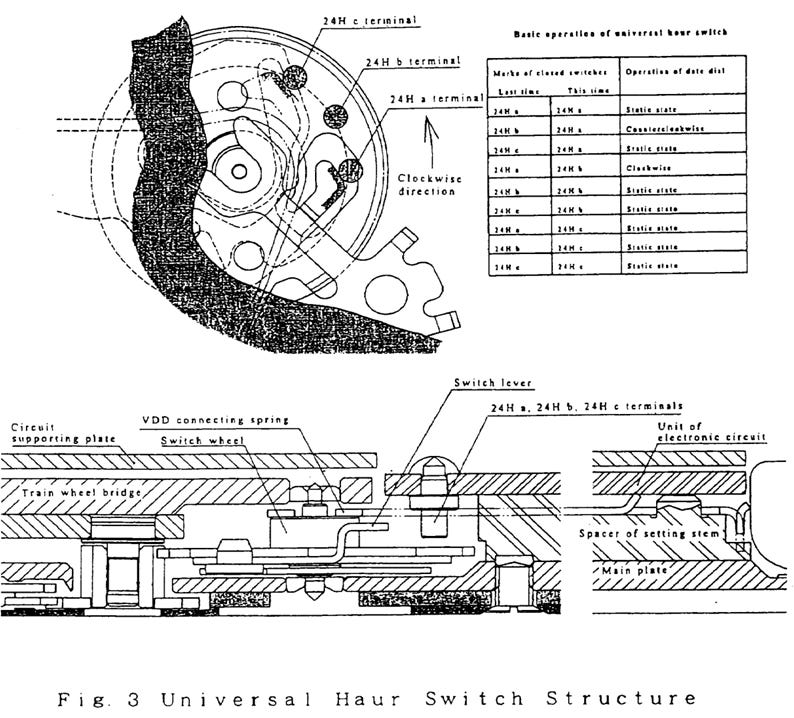
Lest the reader think this is a cop-out that makes the calendar very easy, the presence of the IAHH handed Citizen engineers the challenge of electronically detecting not just when the hour hand has crossed midnight, but also in what direction. As explained in their 1998 paper8:
[The mechanism] is composed of a 24-hour switch that recognizes the start timing of the date change (switching is once per 24 hours), a date step motor drive circuit that controls the calendar information, a calendar control circuit, and a position detection circuit, and as shown in Fig. 2, the calendar mechanism...
The calendar is operated by switching the switch wheel that constitutes the 24-hour switch, which outputs the date step motor signal....
The structure of the switch wheel is shown in Fig. 3. The forward or reverse rotation of the date plate is determined by the combination of the previous and current ON switching as shown in the figure.
The cal. A060 motor-driven calendar, while not mechanically instant, is instant for all practical purposes. (Especially once the novelty of inducing ‘midnight’ with the IAHH just to see the date swap back and forth wears off.)
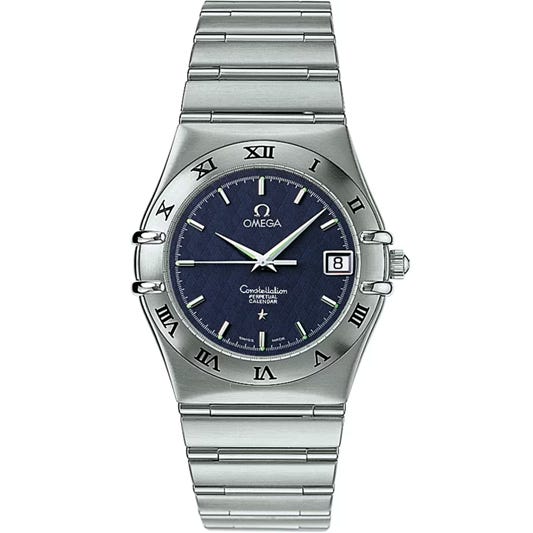
Other movements with a similar design of IAHH and electronic calendar include the ETA 252.611/511 of the Longines VHP and Omega Constellation Perpetual Calendar.
Earlier variant of the Constellation Perpetual Calendar, followed by the Double Eagle variant
Improving the crown feel
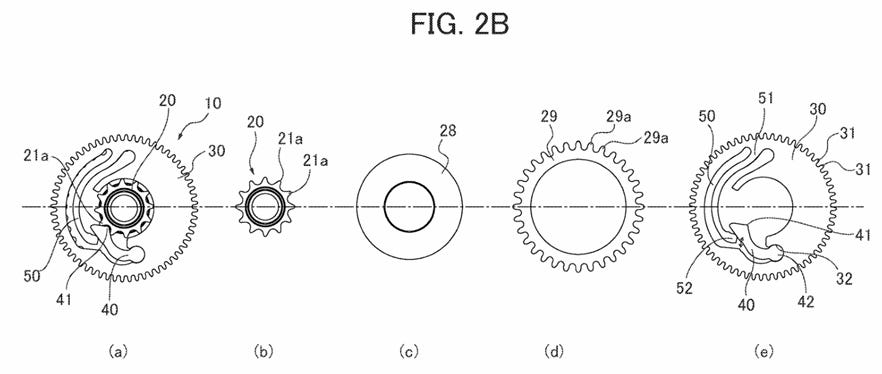
For the 100th anniversary no-date cal. 0100, Citizen developed and patented two mechanical improvements in backlash reduction9 and IAHH.
The IAHH patent10 (PDF attached) alludes to additional design considerations of compactness and crown feel:
[In a conventional design,] it is necessary to form the jumper to be very thin or long to obtain the elasticity of the jumper. In a case that the jumper is formed to be relatively thin, the feeling of moderation (feeling of response that is transmitted to fingers that operate crown) may be reduced when the jumper engages with the jumper pinion. In the case that the jumper is formed to be relatively long, the slip mechanism becomes undesirably large.
The present disclosure has been made considering the above issues and an object of the present disclosure is to provide a time difference correction mechanism and a timepiece with the time difference correction mechanism that reduce the thickness thereof without increasing the size and do not reduce the feeling of moderation
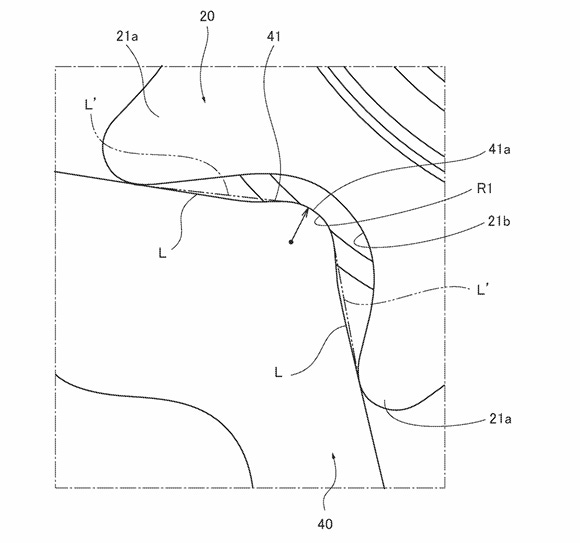
The basic approach is unchanged, but Citizen found a more compact way to arrange the jumper spring. As can be seen below, the spring itself no longer engages the pinion directly, instead pressing on a ‘claw’ (#41) which does.
The profile of the claw was finely optimized for the proper feel when engaging the IAHH:
As described above, it is important to set a relatively large reaction force (feeling of moderation) that is transmitted to the winding stem when the claw 41 climbs over the teeth 21a. Specifically, when the feeling of moderation transmitted to a user who operates the winding stem for the time difference correction is relatively small, the user may stop the time difference correction operation when the claw 41 is on the tip of one of the teeth 21a. In this case, the time difference correction operation cannot be properly performed.
Accordingly, it is necessary to notify the user [by a significant change of resistance] that the hour hand 71 moves only by an angle corresponding to one hour, and it is preferable to increase the feeling of moderation.
By personal comparison among cals. 9F85, A060 and 0100, the 9F85 offers the greatest change of resistance (the ‘feeling of moderation’ that Citizen’s patent refers to), followed by the 0100. This is not surprising as Seiko elected to stack two jumper springs. In other words, the 9F85 has superior feel, but obtained at the cost of a thicker movement.
It would be instructive to also check on the cal. 9R01’s IAHH feel, but alas.
The cal. 0100 project was an opportunity for Citizen to reconsider the modern analog watch. The technologies invented did not merely aim at accuracy even though 1 s/yr is the best-known aspect of the caliber. The effort to improve crown feel and reduce seconds hand wobble and shudder (which in 1,000 fps video is even steadier than that of the 9F) represent mainly aesthetic objectives, with crown feel representing beauty in the non-visual haptic dimension .
The winding feel of the similarly recent Grand Seiko 9SA4 is also about haptic pleasure. So is the action of the Rolex clasp. Something that doesn’t translate well to social media, but is no less real.
IAHH with annual calendar
The Rolex Sky-Dweller’s cal. 9001/9002 and the Patek cal. 31-260 PS QA LU FUS 24H both integrate an annual calendar with IAHH.
The Patek calendar is not instant but accelerated, and the pushers have been lost:
the engineers designed a new self-winding movement in which the Travel Time mechanism controls the Annual Calendar, allowing for forwards and backwards date correction. The second time-zone display, by means of two central hour hands, features an ingenious crown correction system enabling the local time hand to be moved forwards or backwards in one-hour increments. The Annual Calendar, with its accelerated disk passages, ensures optimal synchronization of the date and local time.
IAHH with mechanical QP
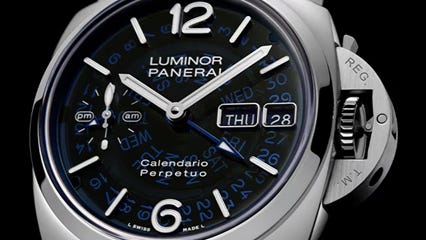
The Panerai cal. P.4100, based on the user manual11, integrates its QP (perpetual calendar) with an IAHH that can be set forwards and backwards.
Therefore, not only is this a bidirectional perpetual calendar predating the AP cal. 7139, it is a bidirectional mechanical IAHH+QP, which the AP is not.
The independently adjustable hour hand (IAHH) has a long history, originating as a convenience and accuracy-preserving feature. Patek Philippe is known for the dual pusher Travel Time interface, while others like Nomos offer single-pusher designs in no-date movements, where the direction of hour correction is not material.
Crown-operated IAHH, presently the dominant form, generally allows bidirectional hour adjustment. When a calendar complication is present, integration with IAHH without compromising either feature is a nontrivial task. The mechanical technology frontier is at the 3-way tradeoff among durability, size and a satisfactory positive feel of the detent.
As the watch world discovers that chronometry is not only about practicality but also the through-line12 of what has and will always set a wristwatch apart from traditional jewelry, wind-up toys, automata and other forms of amusement and adornment, the IAHH should be considered an indispensable feature of every watch at the highest tier of chronometry, electronic and mechanical.
Ostensibly accuracy-focused watches without IAHH include:
Grand Seiko Sping Drive UFA cals. 9RB1 and 9RB2
Longines Ultra-Chron
Chopard 8HF movements
Brequet’s 10 Hz cal. 74SC
Virtually all Rolex 3-hand Superlative Chronometers
Virtually all tourbillons
Subscribe to Performance Watch Review for free to support my work.
Seiko claims the 06LC to be the world’s first 6-digit LCD watch, and gave it the V.F.A. appellation. An early use of titanium casing. Cost two years salary for a college graduate at the time. See also Seiko Epson page.
Some traveler GMTs nevertheless arrange to place the 24H hand below the hour and, such as the Omega 8906, Grand Seiko 9R66/9S86, Miyota 9075, and ETA C07.661.
Some movements following Rolex with IAHH bottommost are Kenissi MT5652 and the ETA A31.11. Discussed in a WatchUSeek thread.
For example, according to Tony Traina: “[Rolex] caliber 3186, found in the GMT-Master II until 2018. A commonly-reported issue resulted from a spring that drove the jumping hour—it was super flimsy. First, this made it difficult to set the time; then, the hour hand wouldn’t move; eventually, it’d rotate freely.”
Based on the P.4100 official user manual, which directs both how to set the date in the future and in the past by moving the hour hand, i.e. going backwards, “.Turn it anticlockwise (b) moving the hour hand (C) backward until the correct date (G) appears in the date window located at 3 o’clock. The correct date has also to match the month (H) and year (J) indicated on the back.”.
It seems absurd that no hands-on review has, in my research, documented the interaction between the IAHH and QP of this caliber. That’s literally the litmus test of a GMT QP.
As Jack Forster stated in “The Importance of Accuracy”, “The second reason I think precision is important, is that if there is a single through-line in the entire history of horology, it’s the pursuit of precision.”
really good stuff! have not seen an article devoted to the iahh before.
i’m of two minds about it. rolex always select their approach to maximize scale. they know most consumers would prefer a quickset date over cycling through the hours to get to the right date. and they also want you to not be content with just an explorer or a sub, they want to give you a reason to also want the explorer ii or gmt 🙂


really good stuff! have not seen an article devoted to the iahh before.
i’m of two minds about it. rolex always select their approach to maximize scale. they know most consumers would prefer a quickset date over cycling through the hours to get to the right date. and they also want you to not be content with just an explorer or a sub, they want to give you a reason to also want the explorer ii or gmt 🙂