Quartz watch energy, quantified
from early quartz to modern solar movements

The available brand range of ‘solar’ watches has expanded in recent years, with Swatch Group, LVMH and Richemont all adding their offerings1 to those of Timex, Junghans, and the Japanese majors. LVMH even took a minority stake in Citizen Group’s Swiss movement-maker Montres La Joux-Perret (LJP) to secure access.
Citizen Group’s Swiss brands Alpina and Frederique Constant have also very recently entered the segment2 after what can only be interpreted as deliberate restraint, with FC even offering a rare 2-hand solar in the Moneta Solarmetre. The sum is a certain beneficial scale to LJP’s solar production line.
‘Solar’, or to be more precise a photovoltaic energy subsystem (hereinafter PV) replaces the disposable battery. But not all designs successfully maintain a surplus of energy in the PV.
Starting with a historical review, this article quantifies and discusses analog quartz energy needs, generation and storage.
Energy needs
The batteries in the first quartz watches, the competition calibers of 1967, only had to last for the duration of the trials, i.e. about a month.
During the first twenty years of commercialized quartz watches, 1970 to 1990, horological engineers rapidly reduced analog quartz’s power draw by about 16 times to around 1 microwatt (μW).3
Below graph illustrates this 4-halvings progress. The figures are maximums inferred from dividing battery capacity by rated runtime (usually a conservative figure).4 For the majority of movements, the extra energy cost of thermocompensation is also present. The intent is not precision of any one plot, but the trajectory over decades.5
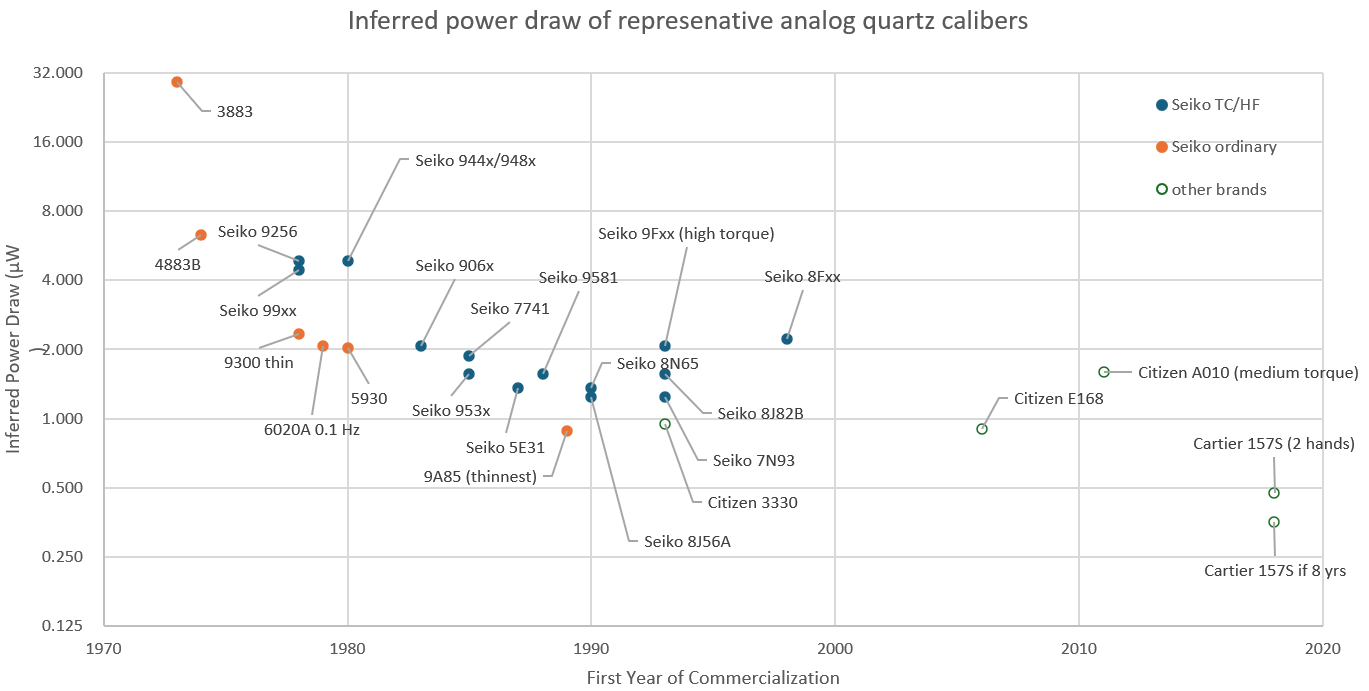
The vertical scale is logarithmic, with each division being a power of 2. In the 1990s, power draw was around 1.3 μW for ordinary calibers and 2.1 μW for the high-torque 9F family.
The state of the art today is a power draw of roughly 1 μW for a low-torque 3-hand movement. Most of this is spent physically moving those hands, the work of which represents a floor to further reductions.
This ‘motor energy’ has seen unheralded feats of ingenuity, including miniature motors (Portescap was an early Swiss pioneer), gearing adapted to torque, and control circuits which ‘chop’ the current to the motor. This ‘adaptive motor pulse method’ (‘asservissement’) cuts the pulse train short as soon as the circuit senses that the geartrain has moved.
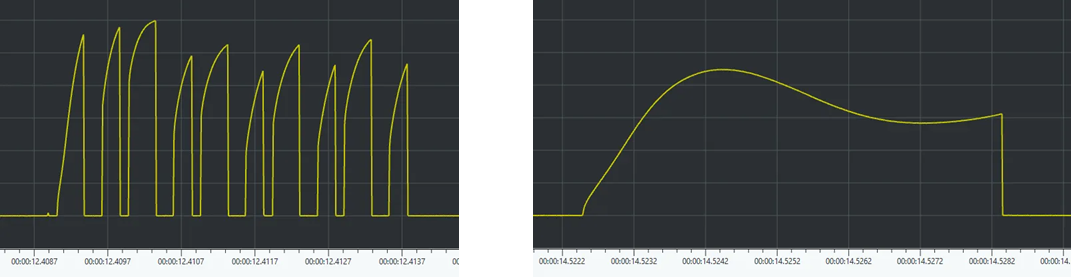
To save energy further, modern two-hand calibers do not contain any ‘ghost’ seconds wheel and only advance the minute hand every several seconds.
Downsizing of batteries
Within the same 1970 to 1990 period, watch buyers tended to value compactness and thinness. Therefore, as makers achieved lower power draw, they also tended to select progressively smaller batteries, such that the typical battery fitted to a 1990s caliber was about a fifth the capacity.
Therefore, non-solar quartz autonomy has not risen by 16 times, but only from 1 year to around 3 to 4 years for a typical three hander. For two handers, the current-production Cartier cal. 157S stands out with a 6-8 year battery life.6
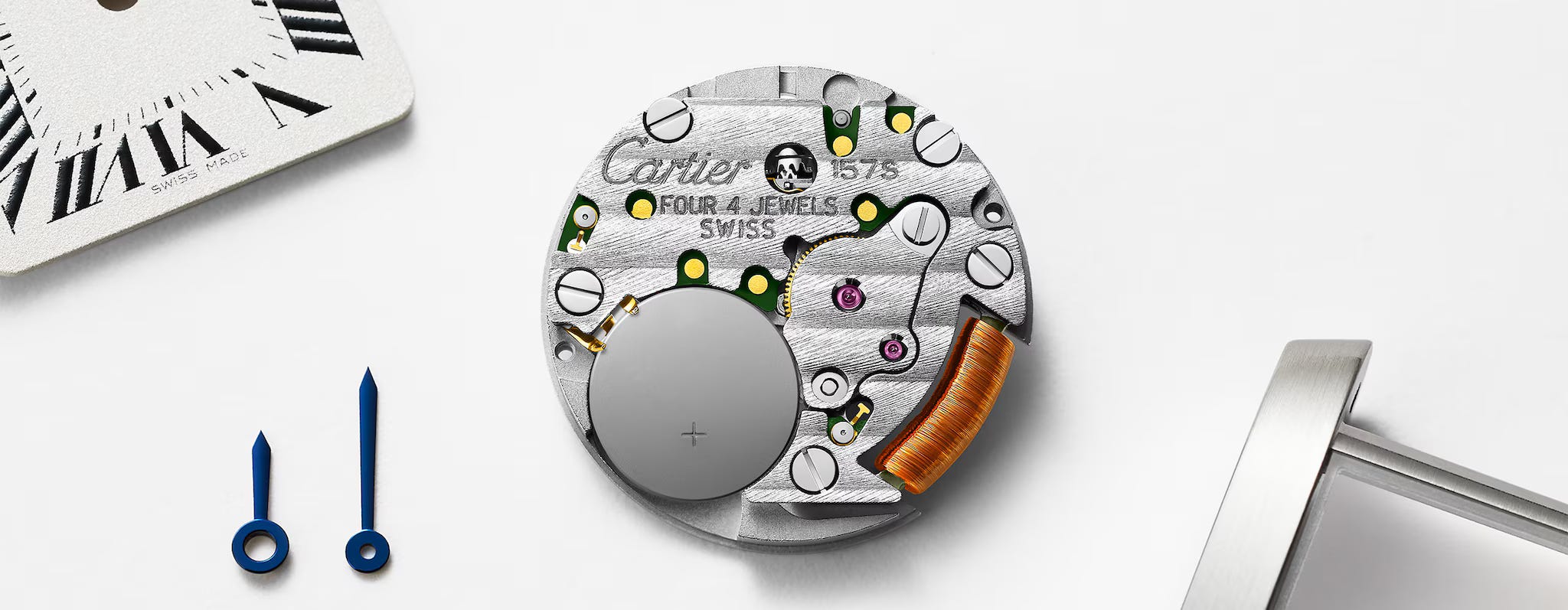
Based on these claims, the movement is drawing only 0.35 to 0.5 μW.
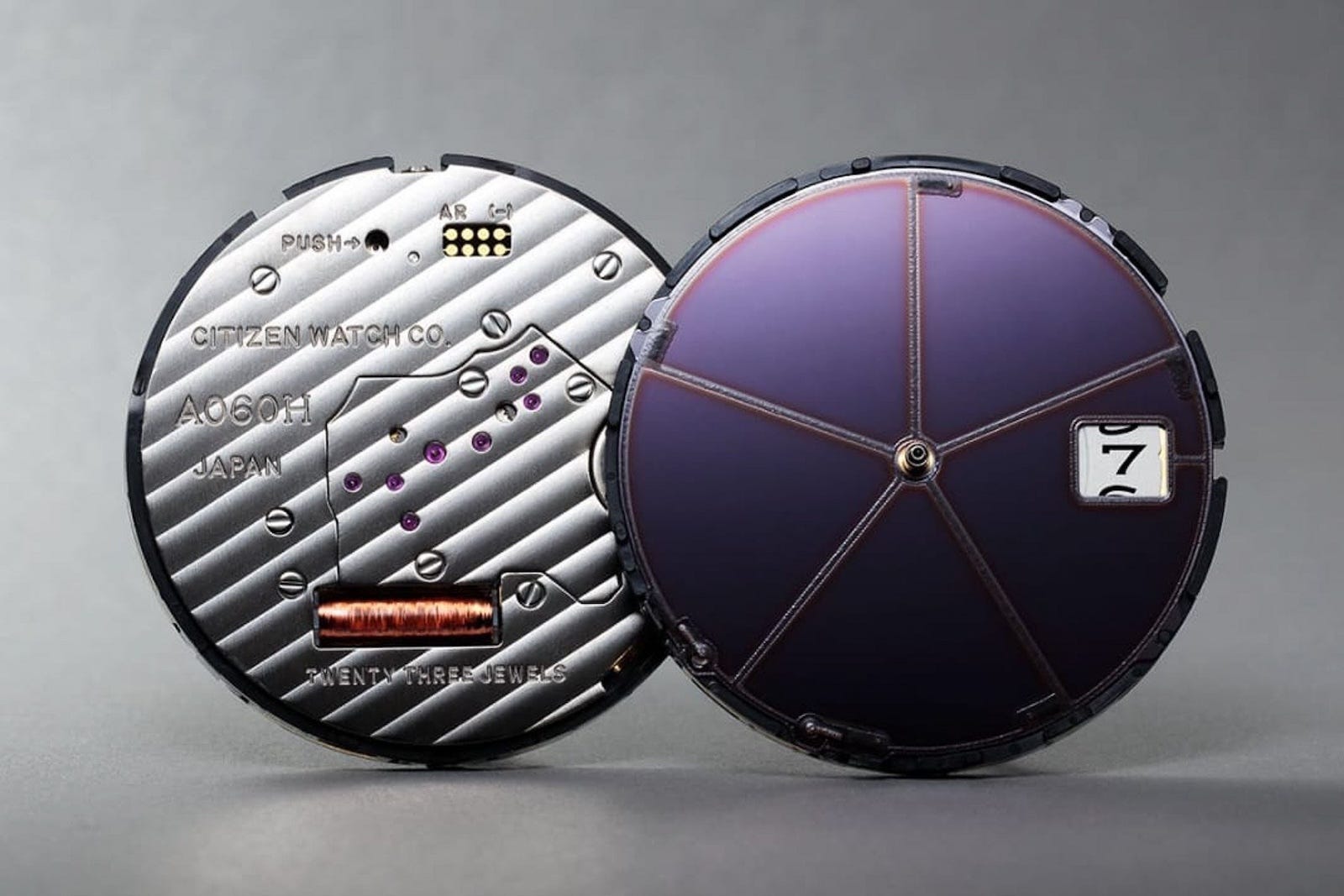
The photovoltaic energy system of the Citizen cal. A060
By all appearances a minor revision to the 2011-launched cal. A010, the cal. A060 powers mainstream The Citizen models. The community has discovered enough about the movement to quantify its PV:
rated runtime fully charged is 210 days (P for pee out)
rated standby time (no hand movement) fully charged is 540 days
full charge at 10,000 lux, representing a bright cloudy day, is 40 hours (R for recharge)
the rechargeable CTL-621F battery holds about 8.3 mWh of energy
The power ratio7 is the recharging power divided by the movement’s power drain. When P is much larger than R, this ratio8 is P divided by R.
P / R = 210 days x 24h divided by 40 h = power ratio of 126
I was pretty impressed by this, having expected something like 10 or 20 times. We can compare this to other movements later, even if we don’t know the battery size, because brands almost universally disclose both P and R.
Dividing battery capacity by P gives us the power draw of the movement:
8.3 mWh / (210 days x 24h) = 0.0016 mW = 1.6 μW
Using the power ratio, the energy generated by the solar cells is 1.6 x 126 = 202 μW.
Since we know that A060 can hibernate for 540 days, the power draw of the timekeeping circuit is 8.3 mWh / (540 x 24) = 0.6 μW, leaving 1.0 μW for motor energy. This is the same hibernation principle as the F.P. Journe Elegante9.
Aside: A060’s light collection efficiency in cased form
The A060 has a ~30 mm diameter solar cell array and roughly the same size of dial opening. Assuming that 10,000 lux sunlight has an energy content of 100 watts per square meter,10 the power of the light falling on the dial opening is (sparing you the math…) 70,700 μW.
Since we earlier determined that the solar cells are only delivering 202 μW to the battery, the PV is only harvesting 0.3% of the light’s energy content.
This low ratio is due to cumulative factors:
tilting and shadowing of the watch in actual use
energy loss passing through the glass
energy loss passing through the dial
conversion efficiency of the solar cells
One plausible (but pro-forma) breakdown of these conversion factors is:
only 50% of the incident light reaching the watch due to tilting and shadowing
only 40% of that passing through the glass
only 10% of that passing through the dial
only 15% converted from light to electricity
which multiply out 0.5 x 0.4 x 0.1 x 0.15 = 0.003.
This suggests that, using the same type of solar calls as the A060, a larger and more transparent dial could yield a healthy multiple of energy, e.g. to power complications.
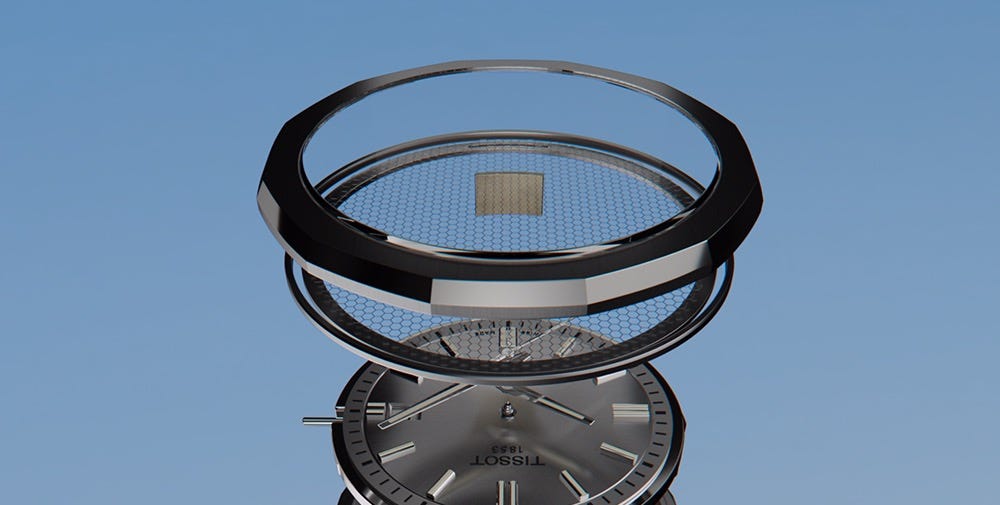
An alternative approach is to gather light above the dial, as in Tissot’s Lightmaster. This avoids the energy loss through the dial material.
Taking stock of the A060
The foregoing indicates the level of overengineering that a half-century of PV experience has taught Citizen is necessary to not inconvenience the watch owner: a >100 times power ratio with outdoor light.
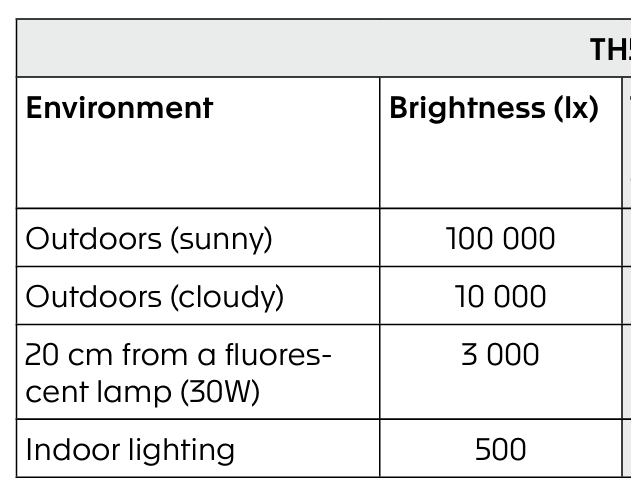
This reduces to a 5:1 ratio indoors, based on TAG Heuer’s Solargraph manual which sets out assumed indoor lighting to be 500 lux, or 1/20th the brightness of this article’s standard 10,000 lux.
Comparison to cal. E168
The Citizen cal. E168 is a volume Eco-Drive movement. Using the same calculations as above, the power draw is an impressively low 0.9 μW.
Power ratio is 108, meaning that indoor light is easily handled, but with a slightly smaller margin as the A060.
The TAG Heuer TH50-00
The belief that the Solargraph movement was based on the ‘economical’ E168 led many to discount the movement. However, the power ratio is much higher at 144, meaning an even higher tolerance for dim lighting.
A higher power ratio on the (presumed) same power consumption has to come either from a bigger dial, higher efficiency cell, or a more transmissive casing. Since E168 is 20 years old, all these factors could have seen modest improvements adding up to 40% more energy generation.
Also, since the runtime is ten months instead of six, the TH50-00’s battery (again assuming the same power draw) must be 60% larger.
GPS watches
A quick check on GPS watches from Seiko (cal. 5X83) and Citizen (cal. F100) show power ratios in the 50s. This probably reflects the high energy demands of regular GPS reception. Such watches may struggle to maintain charge if left unworn in especially dim indoors.
Cartier Solarbeat
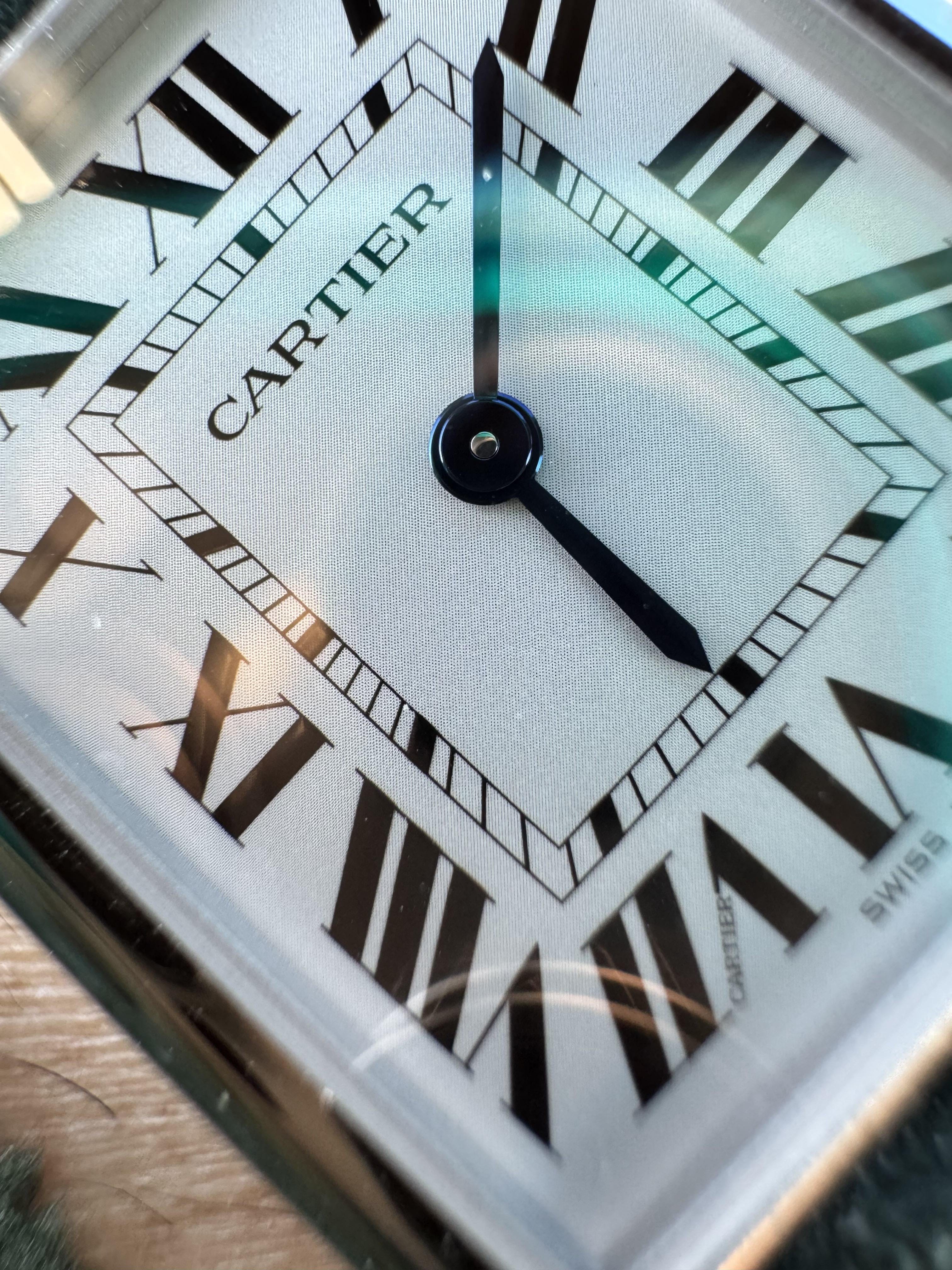
The Tank Must Solarbeat claims to offer the benefits of solar without compromising the dial, by admitting light through micro-perforations.
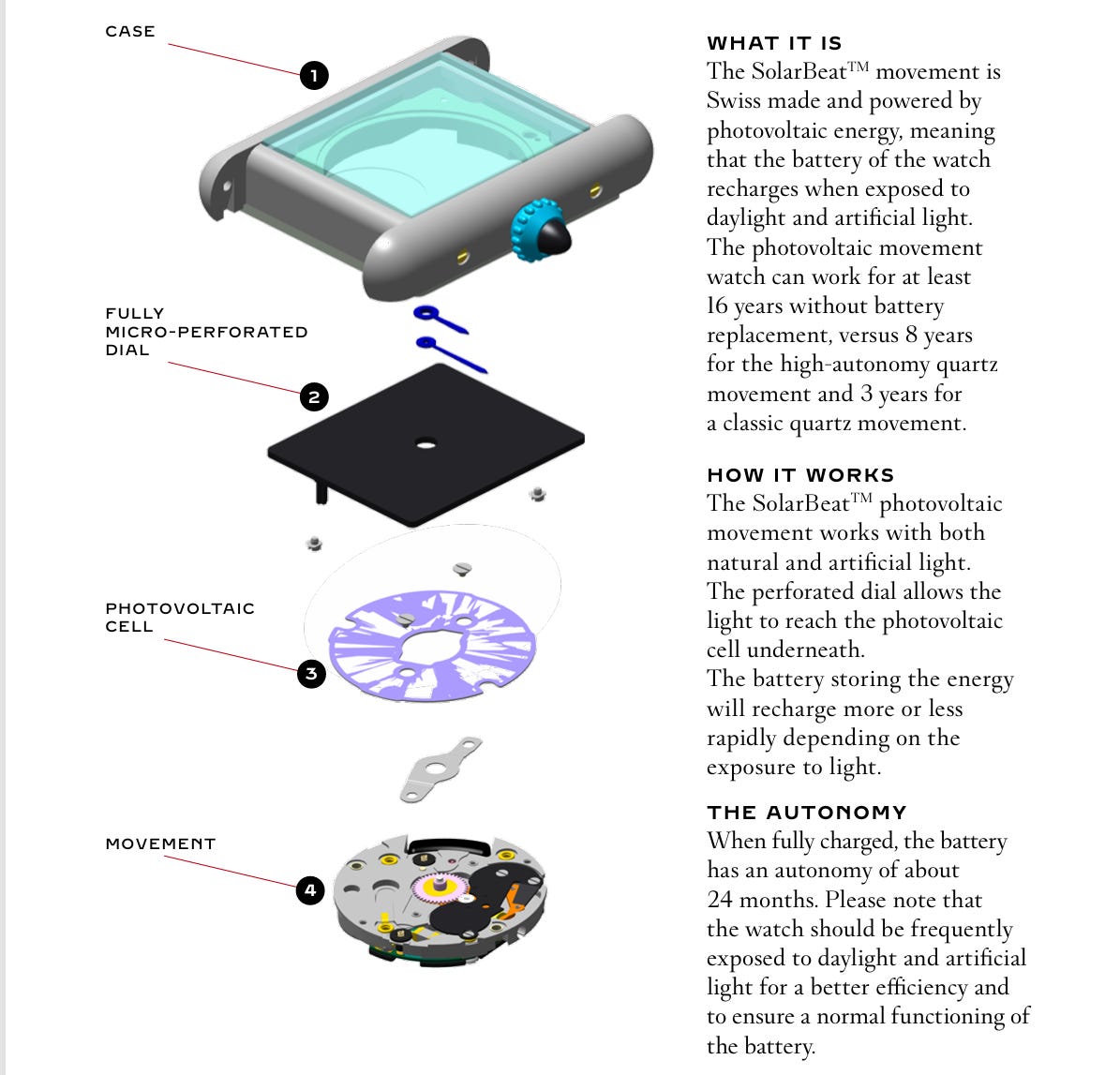
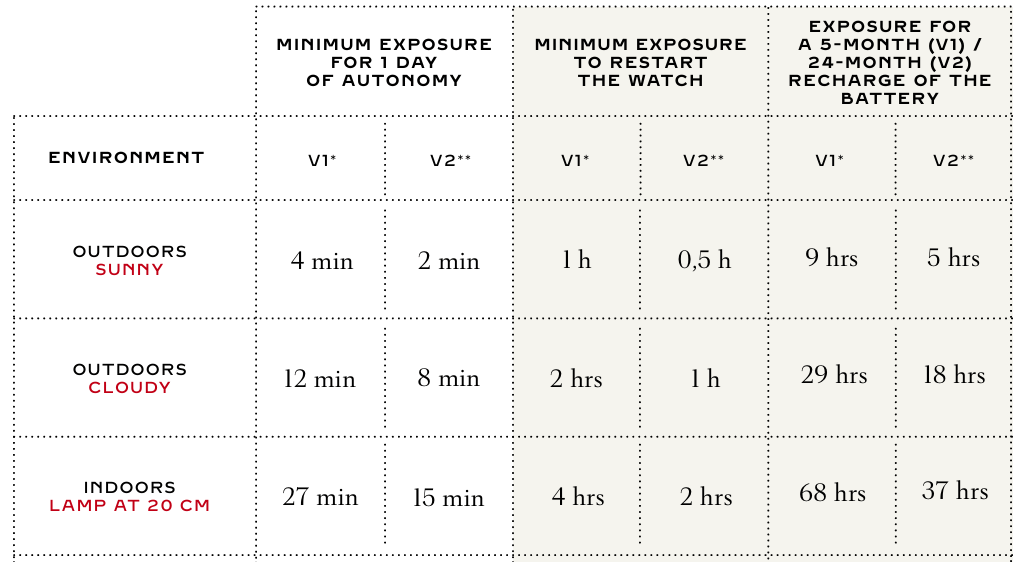
Reading between the lines to apply power ratio analysis:
P = 24 months = 17,520 hours
R = 18 hours at 10,000 lux (‘outdoors cloudy’)
Power ratio = 973 (exceptional)
We can surmise that the initial model which admitted light through the dial lettering only11 had a much lower power ratio, possibly below 100.
Conclusions
Power ratio at 10,000 lux is a fast and easy way to evaluate the practicality of a ‘solar’ watch. A power ratio of 100 or more is recommended for casual watches.
The main reason for seeking higher power ratios is so that the watch seldom or never runs in energy deficit.
For professional use, a lower ratio may be tolerable. Calibers with complications such as chronograph have variable power draw, but with certain judiciously-chosen assumptions of average energy use, can still be analyzed the same way.
P.S.
Solar-powered smartwatches
The 2011 state of the art was around 200 μW from a watch-sized solar panel in outdoor light. Let’s say 400 μW today.
Apple Watch draws 10,000 μW in idle. An Apple Watch is therefore a factor of 25 minimum away from holding charge on outdoor solar power, a factor of 1,250 away from survival on constant indoor light, and a factor of 211 away from being a worry-free solar watch.
Generously assuming the 1970-1990s rate of efficiency gains, which was power draw halving every 5 years, and that solar cells become 100% efficient (saving about 2 halvings), such a fully-solar Apple Watch is 9 halvings = 45 years away or the year 2071, back of the envelope.
That’s assuming the coders neither streamline nor bloat watchOS.
Let’s say that more basic smartwatches from Brand A and B draw respectively 8 and 64 times less power than Apple Watch. That merely chops the feasibility horizon by respectively 3 and 6 doublings to 30 and 15 years away.
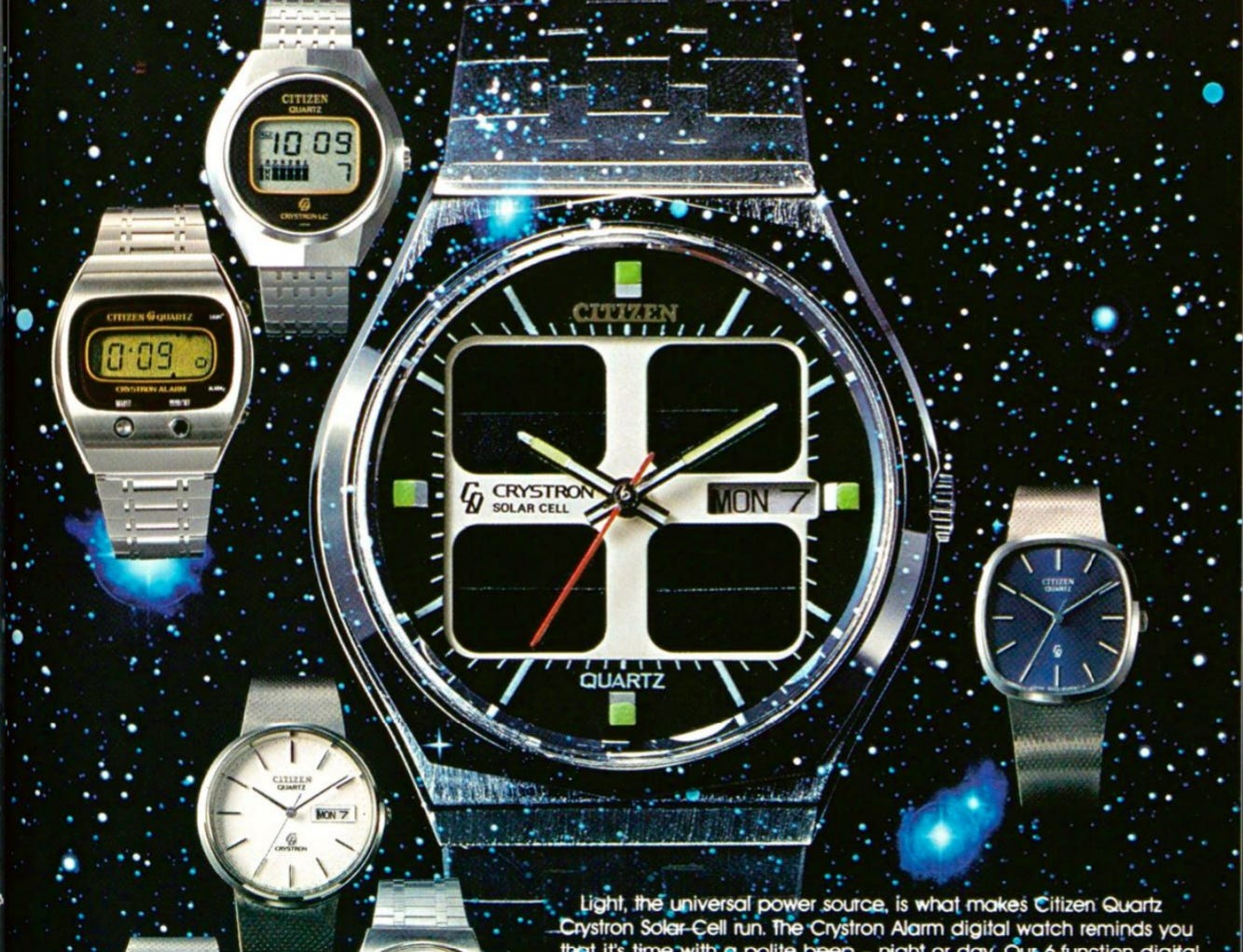
So just like the long slog from the 1975 promise of the Crystron Solar Cell to today, fully solar smartwatches are ‘coming’ but may only arrive when we are (very) old.
What is on the market now are solar-assisted models, which top up the battery in bright light (i.e. out hiking). Some can maintain basic timekeeping on light alone, but that’s nothing impressive to those who have read this article.
T-Touch Connect Solar, PRC Lightmaster, TAG Heuer Solargraph, Tiffany Rope, Cartier Solarbeat.
Alpina in January and FC in May, 2026, both using ‘Solarmetre’ in place of ‘Eco-Drive’.
An idle Apple Watch draws around 10,000 μW with the screen off. The two hand ultrathin Seiko cal. 9A85 is inferred to have achieved 0.9 μW as early as 1989.
Dirty, corroded or unlubricated examples can deliver drastically lower runtime.
The exponential rate of efficiency gains was corroborated for the 1970-1980 period by Kubota (1980)
Another reason that you don’t see 16-year battery life is self-drain. A typical watch battery depletes at a minimum rate whether or not it is powering anything, such that 1/8th the load doesn’t deliver 8 times longer running time.
Lithium batteries have lower self-drain. The ETA 252.611 used a large lithium CR2016 to deliver 10 year battery life.
To be precise, this is the rough power ratio at 10,000 lux.
If P is not a large multiple of R, then a mathematically exact calculation must take into account the fact that the movement is still P’ing during the time it is R’ing.
Back-calculating from Elegante’s advertised sleep life “up to 18 years” using this wattage yields a battery size of 101 mWh, which for a 3 volt battery corresponds to 34 mAh. Based on the size of the battery cover, the Elegante battery is likely the 40 mAh-rated CR1612.
The precise conversion from lux to watts per area is dependent on a host of factors to do with what type of light, but this is a round number because we are talking sunlight. Thanks to the creators of the metric system.
CEO Cyrille Vigneron said in 2021, “There are tiny perforations in the Roman numerals that allow light to pass through the dial and power the cells driving the watch.”
A Solarbeat owner provided additional information without giving sourcing:
In the SolarBeat v1, light was transmitted to the photovoltaic cell and the movement through perforated Roman numerals. In v2, instead of passing solely through the Roman numerals, the light passes through the fully micro-perforated dial.
The Movement has been upgraded with a new and improved battery offering a higher power reserve and improved reliability. The Photovoltaic Cell is now integrated into the movement (previously integrated to the dial).
The enhanced photovoltaic movement can work for at least 16 years without battery replacement, versus 8 years for the high-autonomy quartz movement. With these improvements, the watch’s power reserve is increased from 5 months (v1) to 24 months (v2).
They then supplied a close up photo of the V2 dial perforations